
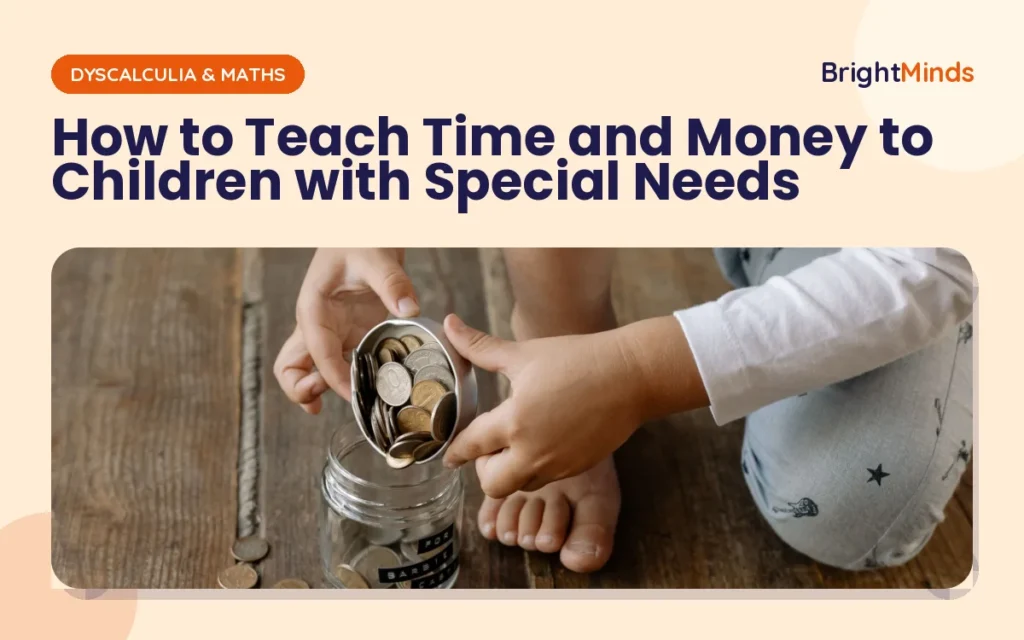
Telling the time and using money are two of the most useful maths skills a child can learn, and two of the hardest for many children with special needs. Both are abstract, both have lots of rules, and both are needed for independence. This guide shares visual, hands-on ways to teach time and money to children with special needs, broken into small steps you can practise at home.
Table of Contents
Before you start: check the foundations
Time and money both depend on earlier number skills. Before starting, check that your child can:
- Count objects reliably (at least to 10 for money, to 12 for clock work).
- Recognise written numbers.
- Understand “more” and “less”.
If these are not yet secure, start there. Our guide on teaching numbers to a child with special needs walks through the basics, and the free numbers quiz offers short practice.

Teaching time
Step 1: Build a sense of time
Before clocks, children need to understand that time passes and that events happen in order. Use words like “first”, “next”, “then” and “finished” throughout the day. A visual schedule helps make the order of the day concrete.
Step 2: Use timers to show duration
Visual timers and sand timers show how long something lasts. “When the sand runs out, we tidy up.” This builds the idea that time can be measured.
Step 3: Connect times to routines
Link key times to familiar events: “Lunch is at 12 o’clock.” Put a photo of a clock showing that time next to the lunch picture on the schedule.
Step 4: Learn o’clock first
Start with whole hours only. Use a large clock with clear numbers. You might cover or remove the minute hand at first so your child focuses on where the hour hand points.
Step 5: Then half past
Once o’clock is secure, introduce half past. Colour-coding helps: shade the right half of the clock face in one colour (“past”) and the left half in another (“to”, for later).
Step 6: Quarter past, quarter to, then five-minute steps
Move on slowly. Practise counting in fives around the clock. Some children find digital time easier first; use whichever works for your child, then build the other.
Time activities to try
- Make a paper-plate clock with movable hands.
- “Clock spotting” on walks: find clocks and read the time together.
- Set the clock to match the next activity on the schedule.
- Match picture cards of routines (breakfast, bed) to clock times.
Teaching money
Step 1: Recognise coins and notes
Start by sorting real coins by look, size and colour. Name each coin. Real money is better than plastic because it looks and feels like what your child will use.
Step 2: Understand value
This is the big leap: a small coin can be worth more than a big one. Use a simple value chart showing each coin next to the matching number of 1p (or 1c) coins. Practise swapping: “Five 1p coins are the same as one 5p.”
Step 3: Pay for one item with one coin
Set up a play shop with items priced at the value of single coins. Your child chooses an item and finds the matching coin.
Step 4: Make amounts with several coins
Move on to making totals: “This costs 7p. Can you make 7p?” Start with 1p and 2p coins, then add others.
Step 5: The “next dollar” or “next pound” strategy
For real shopping, many children with special needs find it easier to round up and hand over the next whole note or coin (for example, if something costs £2.40, give £3). This is a practical, independent strategy that avoids complicated counting.
Step 6: Practise in real life
Let your child pay for one item at a shop with your support. Real practice, even once a week, builds confidence.
Tips for success
- One step at a time. Do not move on until the current step is easy.
- Use real-life links. Time and money make most sense when they connect to things your child cares about.
- Keep sessions short: five to ten minutes.
- Use visual supports such as value charts, colour-coded clocks and number lines.
- Celebrate progress, however small.
If your child finds numbers persistently very hard, read our guide to the signs of dyscalculia in children.
Free to play, no sign-up
Practise this with a free BrightMinds game
- Numbers Quiz: Counting and number recognition with pictures, one question at a time.
- Pattern Game: Spot what comes next in a sequence. Gentle logic practice with no time pressure.
Frequently Asked Questions
Should I teach analogue or digital time first?
Many children start with o’clock on an analogue clock, but some find digital easier. Use whichever works, then build the other.
Should we use real or toy money?
Real money is best, because it looks and feels like what your child will use in shops.
What is the next-dollar or next-pound strategy?
Rounding up and handing over the next whole note or coin. It lets children pay independently without complex counting.
Sources and further reading
- BBC Bitesize Primary: free maths activities, including time and money.
- Understood.org: guidance on maths difficulties and support at home.


