
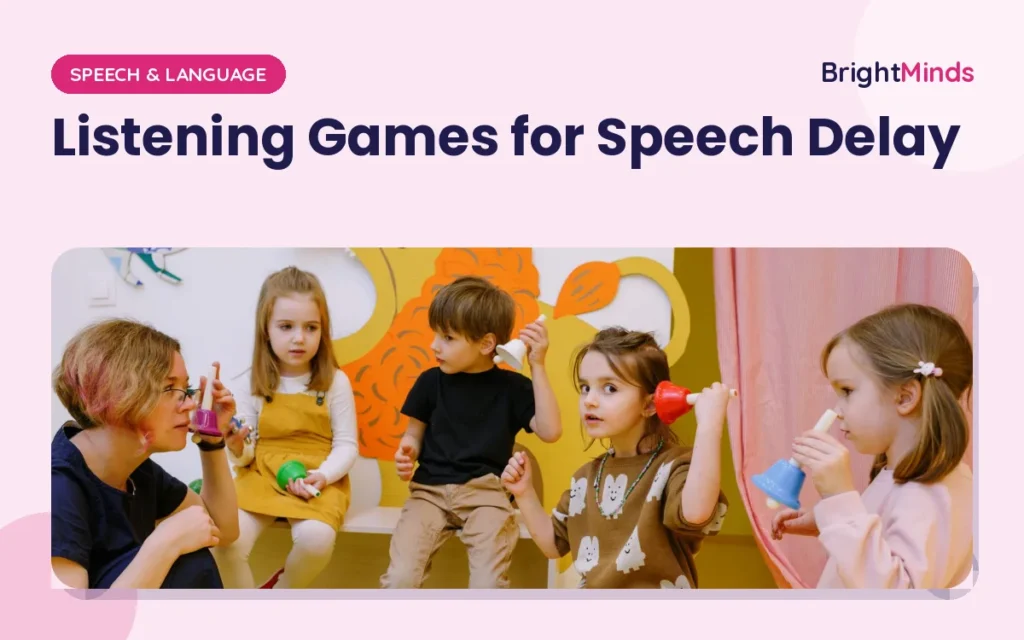
Good listening is the foundation for talking. Before children say words clearly, they need to notice sounds, tell them apart and link them to meaning. These listening games for speech delay are simple to play at home, need no special equipment and take just a few minutes a day. They are a helpful companion to speech and language therapy, not a replacement for it.
Table of Contents
- Why listening skills come before speech
- Before you start
- Listening games for early talkers
- Games for children who are starting to talk
- Games for building sound awareness
- Making listening games part of the day
- When to ask for help
- Frequently Asked Questions
- Sources and further reading
- Related reading
Why listening skills come before speech
Speech and language therapists often describe a pyramid: attention and listening at the bottom, understanding in the middle and talking at the top. A child who struggles to tune into sounds or focus on a voice will find it harder to pick up new words. Building listening skills strengthens that base.
Listening games practise several skills at once:
- Attention: focusing on a sound and ignoring background noise.
- Sound discrimination: hearing the difference between similar sounds.
- Auditory memory: remembering what was heard long enough to respond.
- Turn-taking: listening, then responding, which is the rhythm of conversation.
Before you start
- Turn off background noise. TV, radio and tablets in the background make listening much harder.
- Get down to your child’s level so they can see your face and mouth.
- Keep it short. Two or three minutes per game is enough for young children.
- Accept any response. Pointing, nodding, signing or using a picture card all count.
If your child has not had a hearing test recently, ask your GP or health visitor. Hearing problems, including glue ear, are a common and treatable cause of speech delay.
Listening games for early talkers
1. Ready, steady… go!
Hold a ball or car and say “Ready, steady…” then pause. Wait for your child to look or make a sound before saying “go!” and rolling it. This builds anticipation, attention and the idea of taking a turn.
2. Musical statues
Play music and dance together. When the music stops, freeze. This is a lively way to practise listening for a change in sound, and children love it.
3. What made that sound?
Collect three noisy objects: keys, a shaker, a squeaky toy. Show and play each one, then hide them behind your back or under a cloth and make one sound. Your child points to the object they think made it. Add more objects as they get better.
4. Animal sounds
Use toy animals or picture cards. Make an animal sound and ask your child to find the matching animal. Then let your child make the sound for you to find. Animal sounds are often among the first sounds children copy.
Games for children who are starting to talk
5. Sound and picture match
Play a sound and choose the matching picture. The free Sound Match game does this on screen with clear audio and large pictures. It works well for children who prefer to answer by tapping.
6. Simon says (simple version)
Give one-step instructions: “Touch your nose.” “Clap your hands.” Once that is easy, try two steps: “Touch your nose, then jump.” This builds understanding and auditory memory.
7. Odd one out
Say three words where one starts with a different sound: “ball, bat, sun”. Which one is different? Use pictures to support children who are not yet speaking.
8. Hide and listen
Hide a ticking timer or a phone playing quiet music somewhere in the room. Your child follows the sound to find it. This practises locating sounds and keeps them moving.
Games for building sound awareness
9. Same or different?
Say two sounds or words: “pat, pat” (same) or “pat, bat” (different). Your child holds up a thumbs up or thumbs down. This is useful practice for children who mix up similar sounds.
10. First sound hunt
Choose a sound your child can already make, such as /m/, and look for things around the house that start with it: milk, mum, mat. Our guide to helping a child with speech delay learn the alphabet explains how to connect these sounds to letters later on.
Making listening games part of the day
You do not need a set “therapy time”. Listening games fit naturally into routines:
- At bath time: listen for the water running and stopping.
- On a walk: stop and name the sounds you hear (birds, cars, a dog).
- In the car: play “what’s that sound?” with the radio off.
- At mealtimes: “Can you pass the… spoon?” with a pause for your child to look.
When to ask for help
If you are worried about your child’s speech, you do not need to wait. Speak to your health visitor, GP or nursery. In many areas you can refer your child to a speech and language therapy service yourself. Early support makes a difference.
For more ideas, browse our speech and language guides or read about learning games for nonverbal children.
Free to play, no sign-up
Practise this with a free BrightMinds game
- Sound Match: Listen to a sound and tap the matching picture. Builds listening and phonics skills.
- Letters Quiz: Letter recognition and first sounds, with audio and big, clear letters.
Frequently Asked Questions
Why do listening skills matter for speech?
Children need to notice, tell apart and remember sounds before they can copy them. Listening games build that foundation.
Should my child have a hearing test?
If your child has a speech delay and has not had a recent hearing test, ask your GP or health visitor. Hearing problems are a common, treatable cause.
How long should each game last?
Two to five minutes is plenty for young children. Several short games across the day work well.
Sources and further reading
- Speech and Language UK: advice for parents on talking and listening.
- American Speech-Language-Hearing Association (ASHA): information on speech and language development.


