
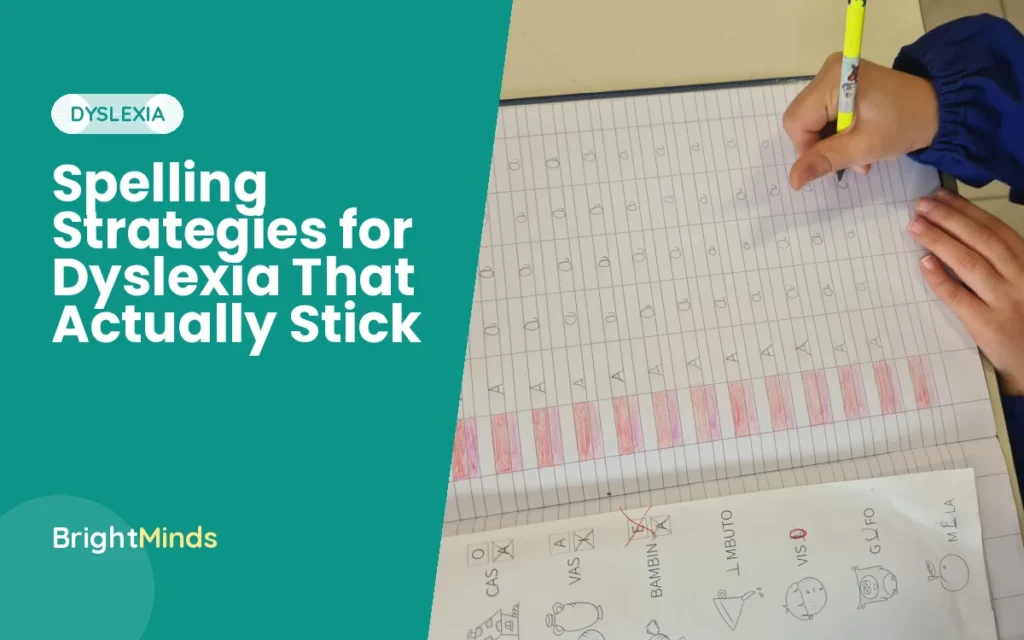
Spelling is often the most stubborn difficulty for children with dyslexia. A word learned for Friday’s test can vanish by Monday. That is not because your child is not trying; it is because spelling needs a secure link between sounds and letters, which dyslexia makes harder. These spelling strategies for dyslexia focus on understanding, multisensory practice and short, frequent review, so words are more likely to stick.
Table of Contents
- Why spelling is hard with dyslexia
- Strategy 1: Sound it out first
- Strategy 2: Teach patterns, not lists
- Strategy 3: Make it multisensory
- Strategy 4: Find the tricky part
- Strategy 5: Use memory tricks
- Strategy 6: Look, say, cover, write, check (adapted)
- Strategy 7: Little and often, with review
- Strategy 8: Fewer words, more success
- Supporting spelling in writing
- Keep confidence high
- Frequently Asked Questions
- Sources and further reading
- Related reading
Why spelling is hard with dyslexia
To spell a word, a child has to break it into sounds, remember which letters represent each sound, and recall any tricky parts that do not follow the usual pattern. Each step leans on phonological processing and memory, the two areas dyslexia affects most. English spelling adds extra challenge, because the same sound can be written in several ways.
That is why rote copying (writing a word ten times) rarely works for children with dyslexia. They need to understand why a word is spelt the way it is, and to practise in ways that involve more than one sense.
Strategy 1: Sound it out first
Before writing, ask your child to say the word slowly and tap or count each sound on their fingers: “c-a-t” is three sounds. Then write one letter (or letter group) for each sound. Use sound buttons (a dot under each sound) or magnetic letters to make the sounds visible.
Strategy 2: Teach patterns, not lists
Group words by pattern so your child learns a rule they can use again: “-ight” (light, night, fight) or “ai” and “ay” (rain, play). Ask the school which patterns are being taught so practice at home matches.
Strategy 3: Make it multisensory
- Say, trace, write: say the word, trace it with a finger on the table or in sand while saying the letters, then write it.
- Air writing: write the word in the air with big arm movements.
- Letter tiles: build the word, mix up the tiles and build it again. The free Word Builder game offers this on screen, with read-aloud support.
- Jump the letters: jump once for each letter while saying them, great for children who need to move.
Strategy 4: Find the tricky part
For words that do not follow the rules (said, was, because), help your child find the part that is unusual and focus on that. Highlight it in colour or draw a picture around it. The rest of the word is often regular.
Strategy 5: Use memory tricks
Mnemonics and silly sentences help with tricky words:
- because: Big Elephants Can Always Understand Small Elephants.
- said: Sally Ann Is Dancing.
- friend: “I will be your friend to the end.”
Children often remember tricks they invented themselves best.
Strategy 6: Look, say, cover, write, check (adapted)
This classic method works better with a few changes for dyslexia:
- Look at the word and say it.
- Say the sounds and spot any tricky part.
- Cover the word.
- Write it, saying the sounds as you go.
- Check letter by letter, and praise every correct letter, not just whole words.
Strategy 7: Little and often, with review
Practise a few words for five to ten minutes a day rather than twenty words once a week. Start each session with a quick review of words from earlier in the week. Coming back to words after a gap is what moves them into long-term memory.
Strategy 8: Fewer words, more success
If the weekly spelling list is long, it is reasonable to ask the teacher whether your child can learn fewer words, or words matched to the pattern they are working on. Learning five words properly is better than half-learning fifteen.
Supporting spelling in writing
- Let your child write first and fix spelling later, so ideas are not lost.
- Provide a word bank of key words for a topic.
- Encourage the use of spellcheck and speech-to-text for longer pieces where appropriate.
- Mark spelling separately from content, and praise good ideas.
Keep confidence high
Children with dyslexia can come to dread spelling. Celebrate progress, however small (“last week you got two, today you got four”), and avoid comparing them with siblings or classmates. For more ways to help at home, read how to support a child with dyslexia at home and our phonics games for dyslexia.
Free to play, no sign-up
Practise this with a free BrightMinds game
- Word Builder: Hear a word, then tap letter tiles to spell it. Includes a read-to-me button.
- Sound Match: Listen to a sound and tap the matching picture. Builds listening and phonics skills.
Frequently Asked Questions
Why does my child forget spellings so quickly?
Spelling relies on sound processing and memory, both affected by dyslexia. Short, frequent review over several days helps words stick.
Is writing words ten times useful?
Rote copying rarely helps children with dyslexia. Understanding the pattern and multisensory practice work better.
Can I ask for a shorter spelling list?
Yes. Many teachers will agree to fewer words or words matched to your child’s current pattern.
Sources and further reading
- British Dyslexia Association: advice for parents on literacy support.
- International Dyslexia Association: guidance on structured literacy and spelling.


